The Amazon's Boiling River Has No Volcano for 435 Miles. Here's What Heats It
A river in the Peruvian Amazon runs close to boiling with no volcano nearby. The heat comes from deep underground, and it may preview the Amazon's future.
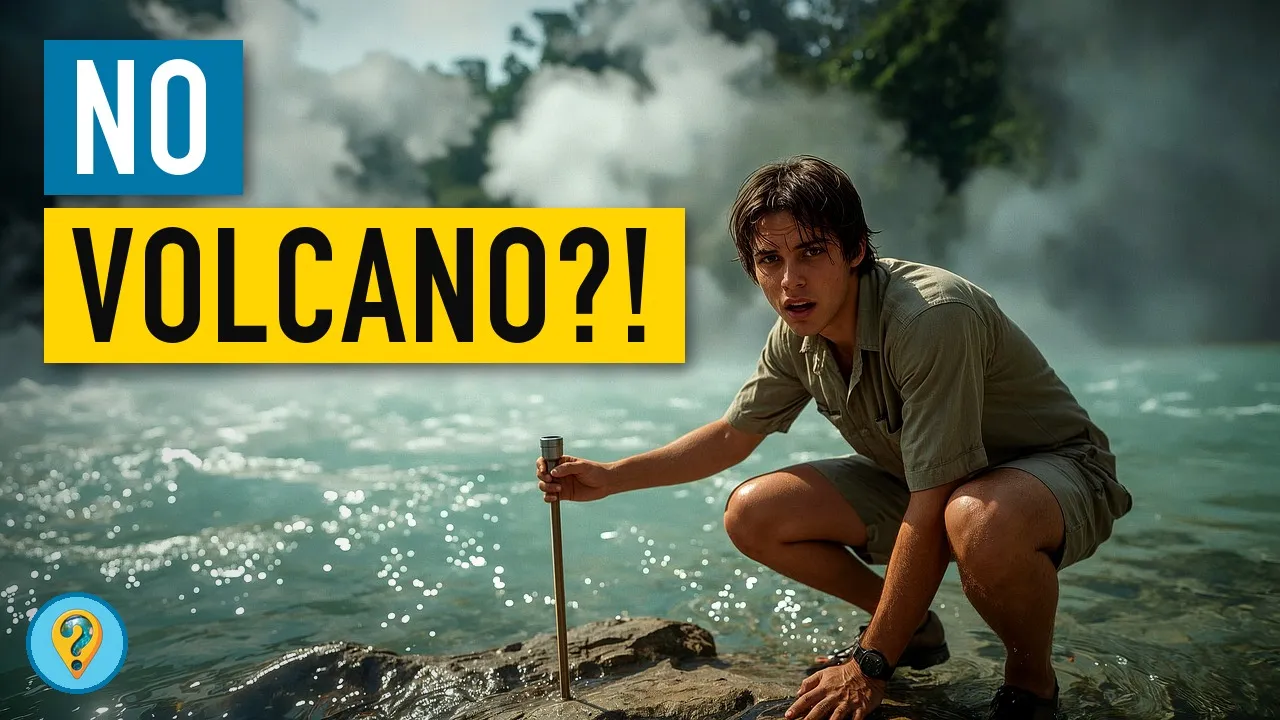
Deep in the Peruvian Amazon there’s a river you should never fall into. In places the water is close to boiling, yet the nearest active volcano is about 435 miles away. The heat comes from somewhere much deeper, and scientists now think this river may be showing us the future of the whole rainforest.
A river you should never fall into
The danger here isn’t piranhas or crocodiles. It’s the water itself.
Small animals that slip in don’t make it out. Steam rolls off the surface like a pot left on the stove. And there’s no volcano anywhere close to explain it.
Meet the Boiling River
Its name is Shanay-timpishka, better known as the Boiling River. It winds through the jungle of central Peru and eventually feeds into the Amazon river system.
At its source, it’s an ordinary jungle stream at about 81°F. Then, for roughly the last four miles, things get strange. The water heats up to around 190°F, and in a few spots it’s even hotter.
For comparison, a hot tub is about 104°F, and a fresh cup of coffee usually lands between 160 and 180°F. Large stretches of this river are hotter than your coffee. It’s no trickle, either. In places, it’s wider than a two-lane road.
Stand on the bank and you can feel the heat on your face. The air is thick with steam, and the water hisses over the rocks. It looks less like a river than a giant soup pot hidden in the rainforest.
Water this hot can cause serious burns in about a second. Nobody swims here, and locals treat the river with enormous respect.
Why it shouldn’t exist
Rivers this hot usually sit near volcanoes, where magma lies close to the surface and heats the water above it. Think Yellowstone or Iceland. This part of the Amazon has no active volcanoes at all.
That’s why, for a long time, the Boiling River sounded like a myth. One scientist almost didn’t believe it either.
As a child in Peru, geoscientist Andrés Ruzo heard a legend from his grandfather. Spanish conquistadors searching for a lost city of gold supposedly faced many dangers in the jungle, and one of them was a river that boiled.
Years later, while working on his PhD in geophysics, Ruzo built a heat map of Peru, measuring how much heat flows out of the ground. His data showed an unusually hot spot in the central Peruvian Amazon. But warm ground is one thing. A boiling river is another.
When he asked other experts, the answer was basically that it was impossible. No volcano, no boiling river.
Then, at a family dinner, his aunt told him, “No, Andrés, I’ve been there.” The river was real. It was also a sacred place, watched over by local shamans who used its waters for healing.
Ruzo and his aunt traveled deep into the jungle to a healing center called Mayantuyacu. With the shaman’s permission, he became the first geoscientist to study the river up close.
On his first day, he asked the shaman’s apprentice for a cup of tea. The apprentice handed him a mug and pointed at the river.
How it boils without a volcano
The answer has nothing to do with fire. It comes from the heat of the planet itself.
Earth gets hotter the deeper you go. On average, the temperature rises by about 1°F for every 70 feet down. That’s why the world’s deepest mines can be scorching.
Chemical tests show that the river’s water started out as rain. Ruzo thinks that rain may fall far away, possibly as far as the Andes. It soaks into the ground and seeps down through cracks in the rock. Deep enough, the rock is hot enough to heat that water to near-boiling temperatures.
There’s a neat bit of physics involved, too. Deep underground, the water is under so much pressure that it can get hotter than its normal boiling point without turning to steam. A pressure cooker uses the same trick.
Then the hot water finds a shortcut back up. The area is crossed by faults, giant cracks in Earth’s crust that work like underground pipes. Where they meet the river, scalding water rises through hot springs and pours in.
The Earth is the stove, the faults are the pipes and the rain is the water. No volcano required.
Why doesn’t this happen everywhere? It seems to take a rare combination: huge amounts of rain to feed the system, deep cracks to carry the water down, and a fast route back up so the water doesn’t lose its heat on the way. At the Boiling River, all three line up.
The water is also remarkably pure. When Ruzo tested it, it had lower conductivity, meaning fewer dissolved minerals, than a famous brand of bottled water. By that one measure, it was cleaner.
A time machine for the Amazon
A river that heats itself without a volcano is only half the story. Scientists recently realized it can do something more valuable: offer a glimpse of the future.
The river’s heat doesn’t stay in the water. It warms the air and the forest around it. Move less than a mile along the river, and the average air temperature can change by several degrees.
That’s similar to the warming the Amazon could face this century under some climate scenarios. In one small stretch of jungle, you can walk from today’s climate into a possible future one.
So a team of researchers did exactly that. They set up 70 forest plots along the river’s heat gradient and recorded the trees growing in each.
They chose trees for a reason. Animals can move to find cooler spots, but trees stay where they sprouted. That makes them a kind of living thermometer, showing the effects of heat year after year.
The result was sobering. For every 1°C of extra warmth, the number of tree species dropped by about 11%. The hottest spots were dominated by heat-tolerant species, the kind usually found in hotter parts of the Amazon.
The researchers suggest that as the Amazon warms, the rainforest could lose some of its variety, with heat-loving species taking over.
Legend meets science
The people who live here didn’t need a study to know the river is special. In local legend, its hot water comes from Yacumama, a giant serpent spirit known as the Mother of the Waters.
Shamans at Mayantuyacu use the river’s water in traditional medicine, and the forest around it is treated as sacred ground. In a way, science and legend agree: the river’s power comes from somewhere deep beneath the surface.
Threatened by what it predicts
A river powered by the planet’s own heat might seem safe. It isn’t.
When Ruzo first visited, getting there took a two-hour drive, a half-hour canoe ride and an hour-long hike. A few years later, new roads had pushed so far into the forest that you could drive almost right up to it.
Those roads brought loggers and illegal clearing. Patches of forest around the river have been cut and burned. Without the trees, soil washes into the water and can change the chemistry of the whole system.
By one estimate, Peru loses roughly half a soccer field of forest every minute. That rate is roughly consistent with Peru’s official Geobosques/MINAM data, which recorded 203,272 hectares of forest loss in 2020 and 137,976 hectares in 2021. Every road that gets closer to the river makes it easier to clear the next patch.
Why it matters
The one place that can show us what a hotter Amazon might look like is itself threatened by the destruction of the Amazon.
There’s good news, though. Ruzo founded the Boiling River Project to research and protect the area, working with local communities and leaders. They’re pushing for official protection, so the river is still around to teach us what’s coming.
Sources
- Andrés Ruzo, The Boiling River (TED Books, 2016)
- Andrés Ruzo, TEDGlobal talk (2014)
- Fortier et al., Global Change Biology, and University of Miami news release (January 2025)
- Science Friday
- The World (PRI), reporting on the Boiling River (2016)
- Xylem/YSI field notes on Boiling River water testing
- ScienceAlert, coverage of Ruzo’s research
- Southern Methodist University (SMU)
- NPR transcript
- The Boiling River Project
- Geobosques/MINAM (Peru), forest loss data